 Space Hub
Bharatiya Antariksh Station (BAS): India's Space Station
India's planned modular space station will expand the country's human spaceflight, microgravity research and long-duration space exploration capabilities.
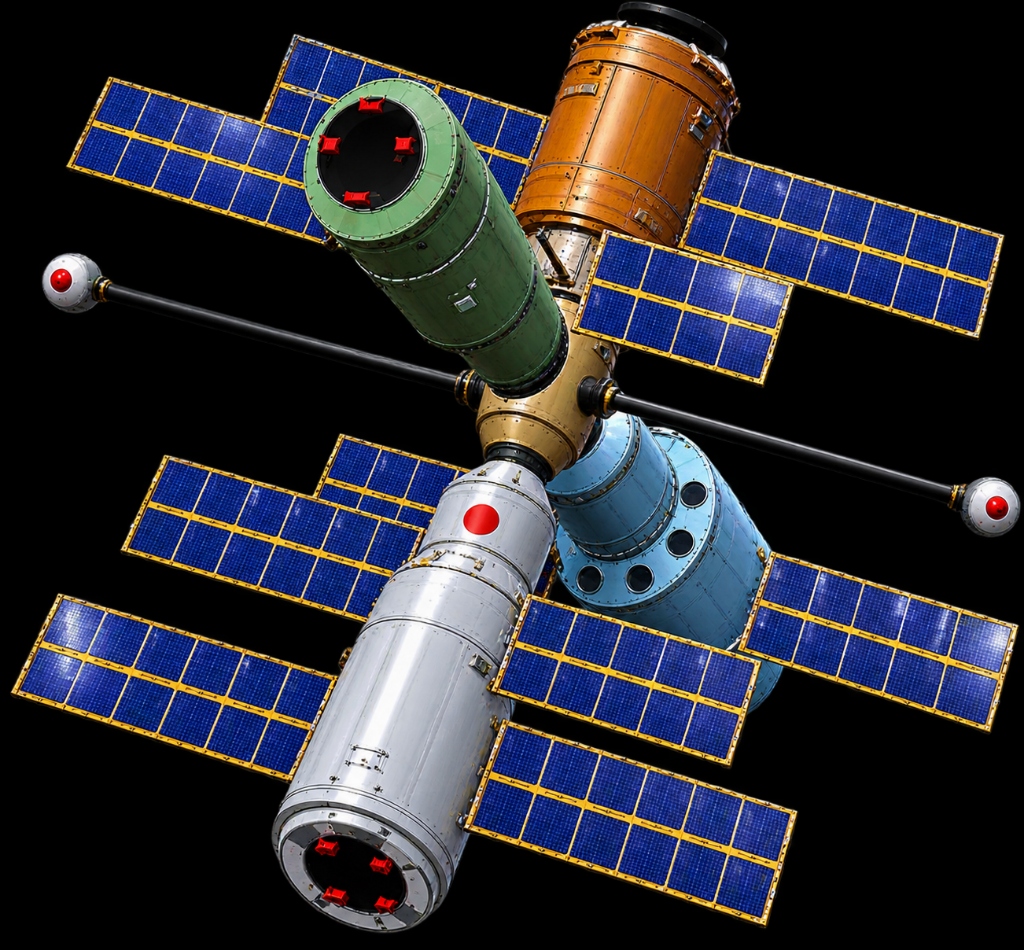
3D concept visualization of the planned Bharatiya Antariksh Station (BAS).
What is the Bharatiya Antariksh Station?
“The Bharatiya Antariksh Station (BAS) is India's planned modular space station, intended to be developed and operated by ISRO. The station is planned as a multi-module platform in low Earth orbit for human spaceflight, scientific research, technology demonstrations and future space exploration.”
What Is the Bharatiya Antariksh Station?
India's Permanent Orbital Outpost
The Bharatiya Antariksh Station (BAS) represents India's next giant leap in space exploration. Serving as a dedicated modular platform in low Earth orbit (LEO), BAS will provide ISRO with continuous human presence capability in space.
Building upon the foundation laid by the Gaganyaan human spaceflight programme, BAS will transition India from initial orbital demonstration flights to sustained long-duration space habitat operations.
Gateway to Microgravity & Lunar Exploration
BAS will serve as an advanced microgravity laboratory for space medicine, biology, materials synthesis, and fundamental physics. It will allow Indian scientists to perform experiments impossible on Earth.
Furthermore, the technologies validated on BAS—such as closed-loop life support, automated docking, fuel cell power systems, and radiation shielding—are essential stepping stones for India's targeted crewed lunar landing by 2040.
Technical Specifications
Planned architectural metrics for the full 5-module Bharatiya Antariksh Station as compiled from official ISRO roadmaps and government disclosures.
| Specification Parameter | Planned Value / Configuration |
|---|---|
| Total Mass | ~52 tonnes (planned combined mass) |
| Station Dimensions | 27 m × 20 m (planned overall envelope) |
| Pressurized Volume | ~265 m³ (estimated total pressurized volume) |
| Habitable Volume | ~105 m³ (estimated total habitable volume) |
| Nominal Crew Capacity | 3–4 astronauts (long-duration stays of 3–6 months) |
| Maximum Short-Duration Crew | 6 astronauts (during crew rotation operations) |
| Orbit Type | Circular Low Earth Orbit (LEO) |
| Orbital Altitude | 400 km – 450 km (planned operational altitude) |
| Orbital Inclination | ~51.5° – 51.6° |
| Total Modules | 5 main modules (BAS-01 to BAS-05) |
| Node Structure | 2 connection nodes |
| Docking Capabilities | Crew & cargo craft docking provisions (BDS) |
| Berthing Mechanism | 4 Common Berthing Mechanism (CBM) ports in Module 5 |
| Robotic Systems | Manipulator robotic arm, free-flying inspection probes & Vyommitra humanoid support |
| Observation Port | Cupola module with multi-viewport observation windows |
| Extravehicular Activity (EVA) | Designed airlock systems supporting astronaut spacewalks |
Development Timeline
Milestones tracking the conceptualization, government approvals, phase-1 module development, and operational targets for BAS.
Initial Space Station Announcement
ISRO leadership publicly presented the conceptual features and preliminary intent for a proposed Indian space station.
Human Spaceflight Roadmap Integration
ISRO unveiled the comprehensive long-term roadmap directly connecting Gaganyaan orbital missions with the future space station architecture.
Union Cabinet Official Approval
The Union Cabinet of India officially approved the development of the initial BAS-1 module as part of the expanded Gaganyaan programme budget.
Phase-1 Detailed Engineering Completed
Detailed design work for the BAS-1 primary structure was completed, confirming compatibility for launch on the LVM3 rocket.
National Space Day Model Unveiling
ISRO publicly unveiled a detailed 1:1 scale engineering model of the BAS-01 module during National Space Day celebrations.
Commercial Industry Participation Call
ISRO's Vikram Sarabhai Space Centre (VSSC) invited Indian commercial aerospace manufacturers to begin hardware construction related to BAS-01.
BAS-01 Base Module Launch Target
BAS-01 (Base Module) is presently targeted for launch into low Earth orbit aboard an LVM3 rocket to begin orbital operations.
Full Station Completion Target
Targeted operational completion of the complete 5-module Bharatiya Antariksh Station complex according to ISRO's baseline roadmap.
Bharatiya Antariksh Station Modules
The station consists of five specialized modular components launched individually and docked in orbit.
Base Module
Initial testbed, primary life support systems (ECLSS), crew quarters and initial orbital operational control.
Core Module
Central structural hub connecting primary station corridors, power management, and navigation routing.
Science Research Module
Dedicated microgravity laboratory for scientific experiments, space biology, and material science racks.
Laboratory Module
Advanced technological laboratory for in-space manufacturing, robotics control, and physics payloads.
Common Berthing Module (CBM)
Houses 4 Common Berthing Mechanism ports for visiting cargo spacecraft, commercial logistics, and expansion nodes.
Robotic Manipulator Arm
A robotic manipulator arm is planned to assist with orbital assembly, payload transfers, exterior inspection, and autonomous berthing support. Prototype robotic arm systems were tested during ISRO's POEM-4 mission.
BAS-01: India's First Space Station Module
BAS-01 is planned as India's inaugural space station module. It will function as a vital technology testbed to demonstrate critical hardware required for long-duration human space habitation.
Key Subsystems & Mechanisms
- ECLSS: Environmental Control & Life Support System for oxygen generation and carbon dioxide scrubbing.
- Bharat Docking System (BDS): Automated active-passive docking ring for Gaganyaan crew spacecraft.
- Bharat Berthing Mechanism (BBM): Heavy-load mechanical berthing latches for future modules.
- Automated Hatch System: Pressure-sealed hatch doors for intra-vehicular astronaut passage.
BAS-01 Fast Facts
How Will India Build the Space Station?
Initial Base Launch
Launch BAS-01 Base Module using LVM3 into a ~400 km circular low Earth orbit.
Orbital Insertion
Deploy initial solar arrays, perform system checks, and establish baseline communications.
Module Launches
Sequentially launch BAS-02 through BAS-05 modules using heavy-lift LVM3 and LVM3-SC variants.
Docking & Berthing
Perform autonomous orbital rendezvous, BDS docking, and BBM berthing procedures.
Structural Integration
Connect electrical power distribution, thermal loops, and ECLSS corridors between modules.
Power Array Deployment
Deploy primary 100 kW-class solar arrays and fuel cell energy storage systems.
Full Crew Operations
Enable progressively longer-duration 3–6 month crewed astronaut missions aboard the completed station.
Bharatiya Antariksh Station Docking Technology
Autonomous docking is critical for space station assembly and crew transfer. ISRO has developed indigenous docking and berthing systems proven through technological demonstrations.
Bharat Docking System (BDS)
Androgynous docking mechanism designed for Gaganyaan crew spacecraft soft and hard docking.
Bharat Berthing Mechanism (BBM)
Heavy-load mechanical latching system used for structural joining of BAS expansion modules.
SpaDeX Technology Demonstration
ISRO's Space Docking Experiment (SpaDeX) demonstrated autonomous twin-satellite rendezvous and docking in orbit.
Autonomous Docking Architecture
BAS features standardized Common Berthing Mechanism (CBM) ports in Module 5 allowing both domestic Gaganyaan spacecraft and international visiting cargo vehicles to dock seamlessly.
How Will BAS Generate Power?
Hybrid Solar & Fuel Cell System
BAS will utilize a dual power architecture combining high-efficiency solar arrays during orbital daylight with Polymer Electrolyte Membrane Fuel Cell Power Systems (FCPS) for eclipse periods.
ISRO successfully flight-tested its 100-watt class Polymer Electrolyte Membrane Fuel Cell aboard the POEM-3 mission on PSLV-C58. The reaction of hydrogen and oxygen produces electricity with pure drinkable water as a byproduct for the astronauts.
Clean Energy & Water Generation
Proven on POEM-3, fuel cells eliminate heavy battery overhead while supplying potable water for life support.
Astronauts on the Bharatiya Antariksh Station
3–4 Astronauts
Standard expedition crew performing routine science experiments and maintenance for 3 to 6 month missions.
6 Astronauts
Short-duration capacity during crew handovers, visiting scientist missions, or joint operations.
3 to 6 Months
Designed long-stay orbital duration for monitoring human health, microgravity adaptation, and psychological resilience.
What Will India Use BAS For?
Microgravity Research
Conduct experiments in fluid physics, protein crystallization, and semiconductor crystal growth impossible in Earth gravity.
Space Biotechnology
Study cell behavior, tissue engineering, and pharmaceutical drug development in long-duration microgravity.
Space Medicine & Human Physiology
Monitor bone density loss, cardiovascular changes, and radiation effects to safeguard gaganauts.
In-Space Manufacturing
Develop precision alloy fabrication, 3D bioprinting, and optical fiber drawing techniques.
Earth & Astronomical Observation
Utilize cupola viewports and external payload mounts for environmental monitoring and astronomical sensing.
Future Lunar Exploration Prep
Validate ECLSS life support systems, extravehicular suits, and closed-loop recycling required for 2040 Moon missions.
International Collaboration
While BAS is an indigenous Indian space station program, ISRO is actively fostering international partnerships for mutual research, astronaut training, and docking standards compatibility.
ISRO – ESA Cooperation
Under the ISRO–European Space Agency Joint Statement of Intent, both agencies explore cooperation in low Earth orbit operations, docking compatibility, astronaut training, analog missions, and potential European research payloads on BAS.
Roscosmos & Global Ties
India maintains interest in strategic space cooperation with Russia (Roscosmos) for life support systems and cosmonaut training expertise, as well as interoperable docking standards for visiting international commercial craft.
Bharatiya Antariksh Station vs International Space Station
| Feature Metric | Bharatiya Antariksh Station (BAS) | International Space Station (ISS) |
|---|---|---|
| Operating Organization | India / ISRO | International Partnership (NASA, Roscosmos, ESA, JAXA, CSA) |
| Planned Orbit | ~400–450 km planned (LEO) | ~418–422 km (51.6° inclination) |
| Module Configuration | 5 planned modular structures | 16 pressurized operational modules |
| Total Station Mass | ~52 tonnes planned mass | ~450 tonnes total mass |
| Nominal Crew Size | 3–4 astronauts | 7 expedition astronauts |
| Primary Mission Focus | Human spaceflight, research, tech demo & lunar prep | International human spaceflight & microgravity science |
| Program Status | Under active development (Target 2028-2035) | Operational legacy station (1998–present) |
Bharatiya Antariksh Station FAQs
Direct answers to common questions about India's planned space station for search engines and AI assistants.
Q1.What is the Bharatiya Antariksh Station?
The Bharatiya Antariksh Station (BAS) is India's planned modular space station, intended to be developed and operated by ISRO. The station is planned as a multi-module platform in low Earth orbit for human spaceflight, scientific research, technology demonstrations and future space exploration.
Q2.When will India's space station launch?
The initial module, BAS-01 (Base Module), is presently targeted for launch in late 2028 aboard ISRO's LVM3 rocket, as part of the expanded Gaganyaan human spaceflight programme.
Q3.When will the Bharatiya Antariksh Station be completed?
The full 5-module Bharatiya Antariksh Station is targeted for operational completion by 2035 according to ISRO and government roadmaps.
Q4.How many astronauts can the Indian space station hold?
BAS is designed for a nominal crew of 3 to 4 astronauts for long-duration missions (3 to 6 months), with a maximum short-duration crew capacity of up to 6 astronauts during crew rotation or joint operations.
Q5.How big will the Indian space station be?
The fully assembled Bharatiya Antariksh Station is planned to have overall dimensions of approximately 27 m × 20 m, with an estimated pressurized volume of ~265 m³ and habitable volume of ~105 m³.
Q6.How much will the Bharatiya Antariksh Station weigh?
The Bharatiya Antariksh Station has a planned total mass of approximately 52 tonnes across its 5 combined modules.
Q7.How high will the Indian space station orbit?
BAS is planned to operate in a circular low Earth orbit (LEO) at an orbital altitude of 400 km to 450 km with an inclination of approximately 51.5° to 51.6°.
Q8.How many modules will BAS have?
The complete Bharatiya Antariksh Station is planned to feature 5 main modules: BAS-01 (Base Module), BAS-02 (Core Module), BAS-03 (Science Module), BAS-04 (Laboratory Module), and BAS-05 (Common Berthing Module).
Q9.What is BAS-01?
BAS-01 is the initial phase-1 base module of the space station. Weighing ~9,186 kg with a 3.8 m × 8.0 m envelope, it serves as a primary technology testbed for environmental control, life support (ECLSS), crew quarters, and automated docking mechanisms.
Q10.What rocket will launch BAS-01?
BAS-01 is planned to be launched into orbit using ISRO's heavy-lift launch vehicle, the LVM3 (Launch Vehicle Mark-3).
Q11.Will astronauts live on the Indian space station?
Yes, Indian gaganauts and international astronauts are planned to live and work aboard BAS for orbital stays ranging from several weeks up to 3 to 6 months.
Q12.What is the purpose of the Bharatiya Antariksh Station?
BAS will serve as India's orbital outpost for microgravity research, space biotechnology, material sciences, human spaceflight physiology, space robotics, and technology preparation for future lunar exploration.
Q13.Is the Bharatiya Antariksh Station operational?
No. The Bharatiya Antariksh Station is a planned future space station under active research, design, and development by ISRO, with the initial BAS-01 module targeted for launch in 2028.
Q14.Is the BAS design final?
The overall architectural parameters and module configurations represent ISRO's baseline roadmap. Detailed designs continue to evolve through engineering reviews and commercial industry participation.
Sources & References
Information on this page is compiled from official announcements by the Indian Space Research Organisation (ISRO), Union Cabinet approvals (September 2024), Vikram Sarabhai Space Centre (VSSC) industry notifications, and public parliamentary disclosures.